
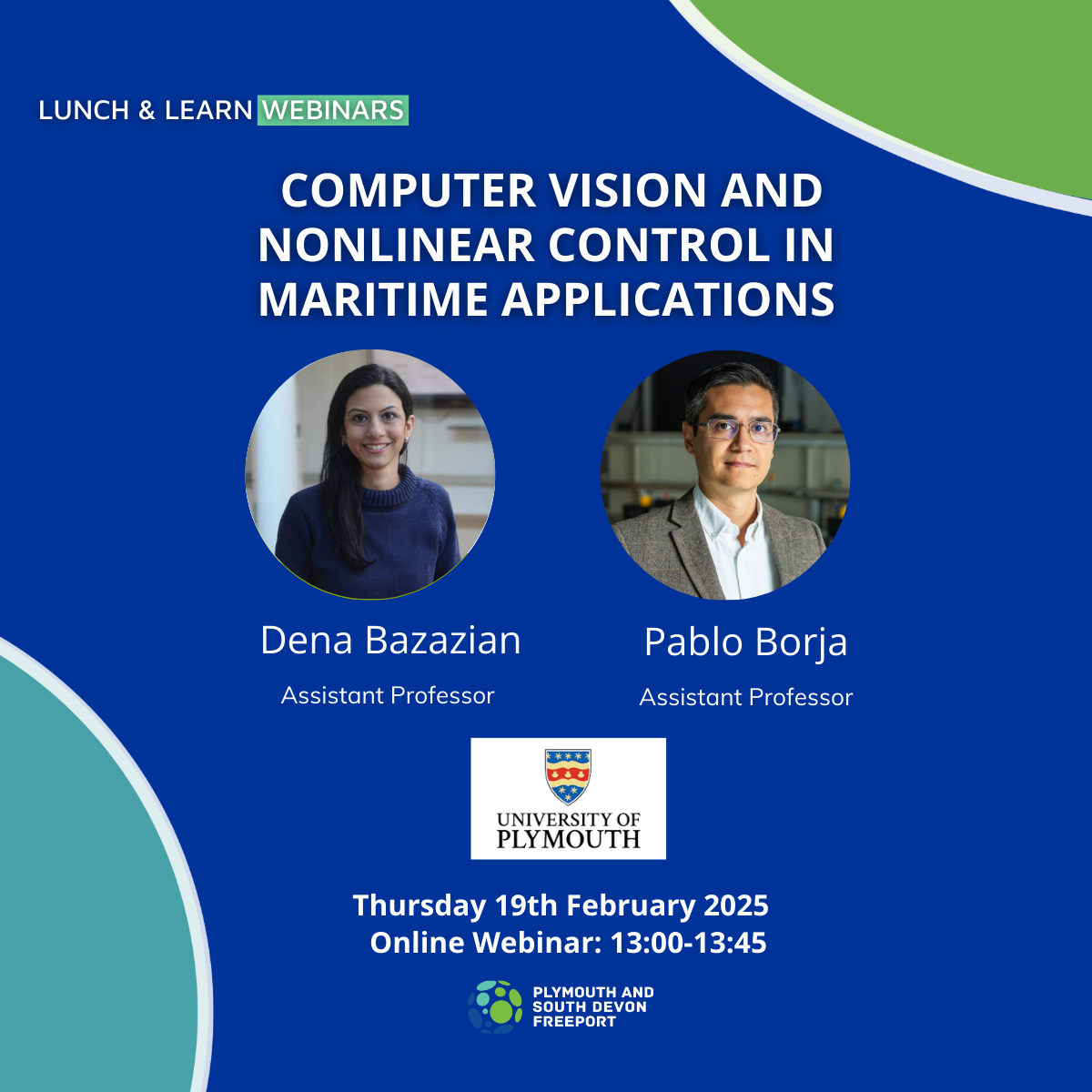
From tracking marine mammals with thermal cameras to coordinating fleets of autonomous vessels, researchers at the University of Plymouth are tackling some of the most complex challenges facing the maritime sector. In a recent Plymouth and South Devon Freeport Lunch & Learn webinar, Dr Dena Bazazian and Dr Pablo Borja Rosales shared the cutting-edge work happening on our doorstep, and what it could mean for the future of the blue economy.
Computer Vision in the Maritime Domain
Dr Dena Bazazian, a lecturer in machine vision and robotics, works on enabling computers to understand what they see underwater, no small task when poor visibility, turbidity, and light absorption degrade every image. Her team has developed techniques to restore colour and clarity before analysis begins, opening the door to a wide range of applications: 3D fish size monitoring for aquaculture, coral reef health tracking, coastal rip current detection in collaboration with the Met Office, and offshore wind turbine inspection using aerial and underwater drones.
She is also working on marine mammal monitoring using thermal cameras, detecting whales and dolphins by the heat of their breath, and on satellite imagery analysis to track harmful sargassum seaweed blooms. In a joint project with Dr Borja Rosales, computer vision has been combined with a robotic arm to detect and retrieve underwater litter.
Nonlinear Control for Complex Maritime Systems
Dr Pablo Borja Rosales, a lecturer in control systems and engineering, designs the algorithms that make autonomous systems behave as intended. His focus is nonlinear control, essential when systems like ships, underwater vehicles, and offshore cranes involve dynamics too complex for conventional approaches to handle reliably. His model-based methods offer something machine learning alone cannot always provide: formal stability guarantees, rapid adaptability to new platforms, and performance that works from day one without vast amounts of training data.
His recent work on formation control, coordinating multiple autonomous vehicles to move as a single, coherent group, is particularly relevant to the future of unmanned maritime operations. “I think in the next five years, probably we’ll see a boom,” he said, pointing to the growing momentum behind uncrewed vessels in both commercial and defence contexts.
Opportunity for the South West
Together, the two fields have direct implications for the Freeport’s core sectors: offshore wind maintenance, marine autonomy, environmental monitoring, and port operations. The session also surfaced an unexpected idea, using computer vision to measure stack emissions from vessels in port, which Dena confirmed is technically feasible and potentially valuable.
You can reach out to Dr Dena Bazazian and Dr Pablo Borja Rosales through the University of Plymouth. Further Lunch & Learn webinars are planned throughout the year, keep an eye on the Plymouth and South Devon Freeport website for details.