
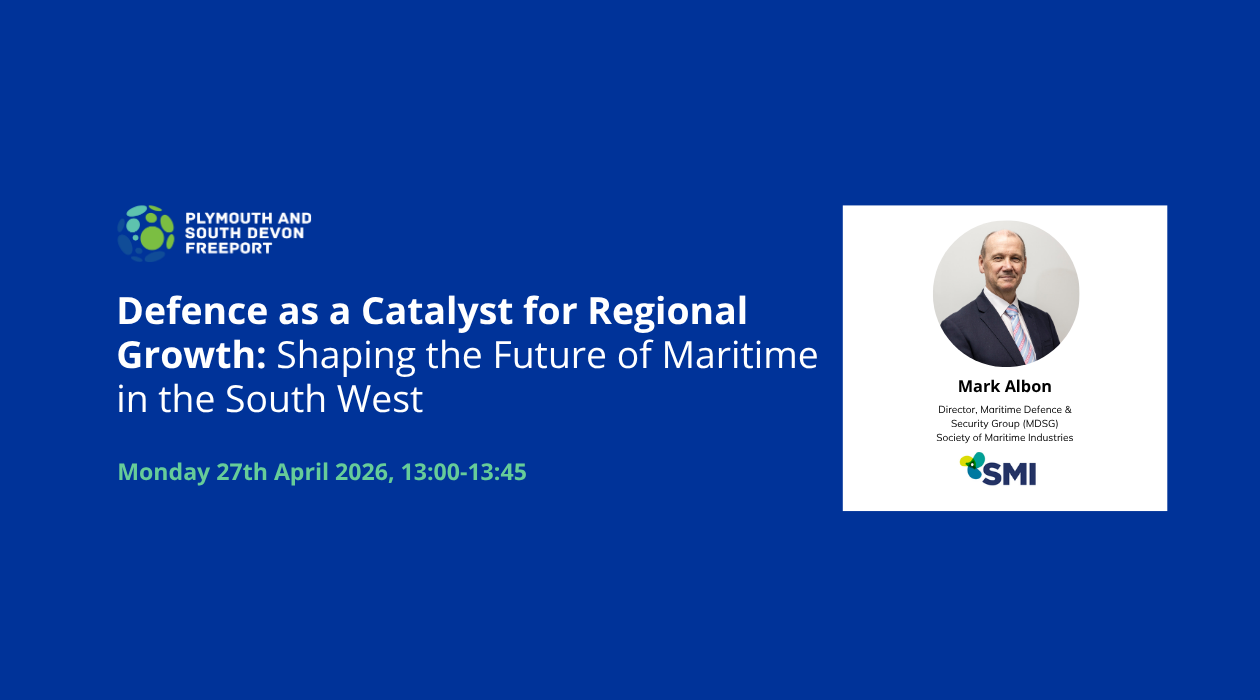
Plymouth and South Devon Freeport recently hosted a webinar bringing together businesses from across the region to hear from Mark Albon, Director of Maritime Defence and Security at the Society of Maritime Industries (SMI). With over 34 years of Royal Navy experience and a front row seat to how defence procurement actually works, Mark offered a frank and compelling picture of where the market is heading and what it means for businesses right here in the South West.
His opening point was simple but striking. We are entering one of the most significant growth periods in maritime defence and security in decades, and this is not a short-term spike. It is a structural shift, with a demand horizon of 10 to 20 years, and in the case of programmes like AUKUS, stretching well into the 2060s. UK defence spending is rising towards 2.5% of GDP, with 3% targeted by the end of the next Parliament. Programmes already underway, including the £4.4 billion submarine infrastructure programme through Team Plymouth, are on contract and delivering over the next decade. The question, as Mark put it, is not whether this market will grow. It is whether businesses in this region are positioned to benefit.
For those wondering whether defence is really relevant to them, Mark was emphatic: Plymouth and the wider South West are already embedded in the system. A large supplier of one of the most significant naval support facilities in Europe, is on our doorstep. The Royal Marines are at home here. The University of Plymouth is leading the development of the National Centre for Marine Autonomy, backed by a further £50 million investment announced earlier this year. Plymouth City College has been named a DTech hub with £10 million in defence funding. And the Smart Sound regional testbed is already contributing to future naval capability. Marine autonomy, Mark noted, is possibly the fastest growing area in the entire defence sector, and the South West is already leaps and bounds ahead of other regions in building a coherent ecosystem around it. “If it’s anything autonomous in the water,” he said, “it should be down in the South West. That’s where investment should go.”
Most businesses in the region are unlikely to sell directly to the MOD, and Mark was clear that this is not where the primary opportunity lies. Beneath the major primes sits a vast network of long-term support contracts, infrastructure work and specialist SME supply chains, spanning subsea infrastructure protection, naval maintenance, uncrewed systems, data and sensing integration, and alternative fuels. Getting into that ecosystem is the real prize, and the Plymouth and South Devon Freeport, Mark argued, is a key enabler in making that happen, creating the conditions for growth and providing the space businesses need to scale. Though he was equally clear that Freeport status does not create growth on its own. Businesses do.
On the practical side, Mark was candid about the challenges. Defence is a structured system, not an open market, and if you are not visible within it you are effectively invisible to procurement altogether. That means being registered on JOSCAR, engaged with the Defence Sourcing Portal, tracking opportunities through Contracts Finder and aligned to cyber standards like Cyber Essentials Plus. The newly established Office for Small Business Growth, sitting within the National Armaments Directorate, has been set up specifically to help SMEs navigate this landscape and act as a single point of contact into the MOD. Mark described it as one of the most forward-looking things the MOD has done in recent years. His broader advice was straightforward: define your relevance to defence early, build relationships before you need them, invest in the right accreditations, and use every network available to you, whether that is trade bodies, clusters, Team Plymouth or the Freeport itself.
The session closed on perhaps its most important point. The biggest risk for the South West is not a lack of capability. It is fragmentation, strong individual companies presenting a weak collective proposition. Regions that align behind a clear identity will attract investment. Those that do not will be bypassed. The South West’s growing identity as the UK’s home of marine autonomy is a powerful platform, but only if businesses, institutions and partners continue to pull in the same direction.
As Mark put it, “there are really two futures here. One where the South West becomes a leading maritime defence cluster, with growth, exports and high value jobs. And one where the work goes elsewhere and businesses here remain at the margins. Both are realistic. But only one requires action.”
To find out more about the opportunities available through Plymouth and South Devon Freeport, get in touch with eifion.jones@pasdfreeport.com